PRAVESH TO RAJYAPURASKAR
THIS BLOG PROVIDES YOU ALL ABOUT THE NOTES OF SCOUT SYLLABUS STARTING FROM
PRAVESH
TO
RAJYAPURASKAR ......................

PRAVESH
1. Have a general knowledge of the scout movement.
2. Scout law and scout promise.
3. Scout motto, sign, salute and left hand shake.
4. Good turn.
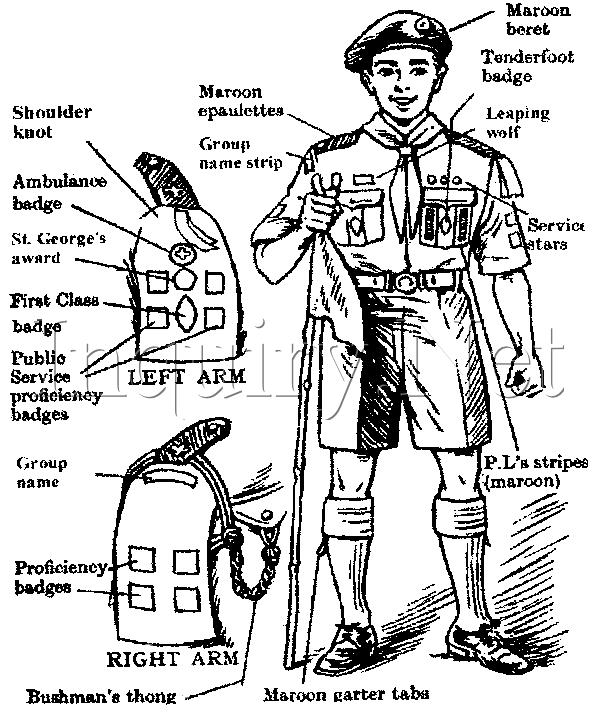
5. Uniform:- Know the parts of uniform and how to wear it.
6. Know the composition and significance of the National flag, Bharath scouts and guides flag and world scout flag.
7. National Anthem:- Sing correctly the National anthem.
8. Prayer song and Flag song.
1. Have a general knowledge of scout movement.
Lord Badon powell of Giwell chief scout of the world

Robert Stephenson Smyth Baden powell know to millions by his magical initials. B.P is founder of the Boy Scout and Girl Guide movement was born in London on the 22nd February 1857. He was the sixth son of professor H.G Baden powell and Henrietta errance, danghter of Admiral William smith professor Baden Powell died when B.P was three years old and the bunder of bringing up the families, therefore, developed entirely on MR. Baden powell. He allowed them a good deal of freedom to go about and learn things from themselves. This early up bringing gave B.P. The real start for his future life as a solding and an out doors man.
He collected together twenty boys and held in a camp for them on BROWN SEA ISLAND is august 1907. After the grate and successful camp he decided to write his how famous book scouting for boys. It was published in 1908. Boys every were in England began to buy his book to start. Scouting on their own. Thus patrols and troops began to spring up rapidly all over England.
After the formation of the bag scout movement. B.P come to India twice, once is 1921 and again in 1937 to attend the first all-India Jamboree in Delhi and to attend in third separate organization. After going back he attended world Jamboree in Holland. This was the last Jamboree.
The ends come suddenly on the 8th January 1941. He was buried in Nyeri amidst nature's most beautiful vistus with his head to the North to the snow copped mountains of Kenya which he loved so much.
2. Scout law and scout promise.
SCOUT LAW
1. A scout is trust worthy
2. A scout is loyal.
3. A scout is a friend to all and a brother to every other scout.
4. A scout is courteous.
5. A scout is a friend to animals and loves nature.
6. A scout is disciplined and helps to protect public property.
7. A scout is courageous.
8. A scout is thrifty.
9. A scout is pure in thought, and deed.
SCOUT PROMISE

On my honor, I promise that I will do my best:-
1. To do my duty to God and my country.
2. To help other people and
3. To obey the scout law.
3. Scout motto, sign salute and left hand shake
SCOUT MOTTO
Be prepared!
Meaning: - 1. Physically strong
2. Mentally Awake
3. Morally straight.
SCOUT SIGN
The sign is given at the time of investiture or at time of renewal of the scout promise.
1. The 3 finger represents 3 fold promises.
2. Thumbs finger over little finger represents the younger should obey the elders .
SCOUT SALUTE

It is always done with the right hand. It is the privilege of the one who sees first to salute first - Irrespective of rank.
LEFT HAND SHAKE
"THE Bravest of the Braves"
Our Founder conceived left hand shake as a form of greeting for the members of the movement. The idea originated from an incident in his military career in South Africa.
When Colonel Baden Powell entered the capital city of the Ashanti people in 1896 he was met by one of the chiefs named prempeh who came to him holding out his left hand. B.P held out his right in return but the chief said: NO, in my country the bravest of the brave shake with the left hand. So began the left handshake of the world wide brotherhood of scouts.
4. Good Turn Every day
5. Uniform: - know the parts of uniform and how to wear it.

1. Barrel
2. Badge
3. Owgal
4. Brother Hood badge
5. International scout badge
6. Scarf
7. Belt
8. Rope
9. Socks
10. Shoes
6. Know the composition and significance of the National flag, Bharat scouts and guides Flag and world scout flag.
NATIONAL FLAG

The National flag of India was adopted in its present from during a meeting of the constituent Assembly held on 22nd July 1947, 24 days before India’s independence from the British on 15th August 1947,
Designed by: Pingali venkayya. Tricolour “saffrom” at the top, white in the middle, and green at the bottom. In the centre, there is a navy blue wheel with 24 spokes, know as the Ashoka chakra.
THE BHARAT SCOUT AND GUIDES FLAG

The Bharat scouts and Guides flag shall be in dark blue colour, the emblem in golden yellow shall be in the centre of the flag with Ashoka chakra in blue colour.
Size of association Flag: 180 cm x 120 cm
Size of troop Flag: 120 cm x 80 cm
Size of emblem in Flag: 45 cm x 3 cm
Ratio of the Flag: 3:2
WORLD SCOUTS FLAG

The world scout flag consists of the world scout badge in a white encircled by a white reef knot. It is set on purple back ground, the size of the flag will be in the ratio of 3:2. Purple is the international colour and stands for the service oriented nature of scouting. The knot is the symbol of the scout brotherhood.
The flag was approved in 1951 at the 8 the world conference held in Lisbon.
7. National anthem
The Indian national anthem, composed by Rabindranath Tagore, it was first sung at Calcutta session of Indian national congress on 27th December 1911. jana gana mana was officially adopted by the constituent. Assembly as the Indian national anthem on January 24th, 1950. Timing: 52 sec
Jana gana mana adhinayaka, jayahe
Bharata bhagya vidhata
Punjab sindhu Gujarata maratha
Dravida utkala ganga
Vindhya himachala Yamuna ganga
Uchala jaladhi taranga
Tava shubha name jage
Tava shabha ashish maange
Gahe tava jaya gatha
Jana gana mangala dayaka jaya he
Bharata bhagya vidhata
Jaya he, jaya he, jaya he
Jaya jaya , jaya, jaya he!
8. PRAYER SONG
Written by : veer deva veer LT/s former soc, Haryana, one of the freedom fighter.
Daya kar dan bhakti ka
Hamen pareamathma Dena,
Daya karana hamari atma
Men suddhata Dena.
Hamare dhyan men aoo
Prabhu ankho men bas jao.
Andheri dill men aakar ke
Param jyothi jaga Dena.
Bahado prem ki ganga
Dilon men prem ka sagar,
Hamen apas me miljulkar
Prabhu rehna sikha Dena.
Hamara kaarm ho seva,
Hamara dharm ho seva,
Sadai man ho seva ho
Sevakchar Bana Dena.
Vatan ke vaste jeena,
Vatan ke vastes marna,
Vatan per jan Fida karma
Prabhuy hamko sikha Dena.
FLAG SONG
Bharat scout guide jhanda
Uncha sada rahega,
Uncha sada rahega jhanda
Uncha sada rahega.
Neela rang gagan sa vistrut
Bhatru bhav failatha,
Tridal kamal nit teen pratigna onki yad dilate.
Aur chakr kehata hei
Prathipal agey kadam badega.
Uncha sada rahega jhanda
Uncha sada rahega.
Bharat scout rahega.
PRATHAMA SOPAN
Ø Learn about your patrol, its flag, yell or song and corner.
Ø Know general rules of health, practice B.P six exercise or six asana or surya namaskara .
Ø Whipping, roof knot, sheet bend, clove hitch, bowline.
Ø Learn wood craft signs and follow a track.
Ø Learn and practice hand and whistle signals.
Ø Know the contents of first aid box.
Ø Participate in 2 patrol outdoor meeting or a patrol day hike.
Ø Adopt for purpose of keeping clean a park.
Ø Participate nine any 2 of the following:
a) Undertake a nature study project.
b) Discuss with your scout and render some services involving any one of the points of scout lay and sumit a report to your scout master.
c) Visit a village panchayat samiti block development office municipal office and learn about the service.
12) Daily good at home and maintain a dairy at least for a month.
Test for pratham sopan
1) Know the patrol call and general rules of heal exactise B.P six exercise or six asana or namaskara.
2) Learn wood; craft sign’s and follow a track.
3) Tie and show uses of ;rope knot sheet bend.
4) Participate in troop games.
5) Practice orderly movements and simple drill for smartness.
6) Know the content’s of the first aid box. Demo the use of roller bandages and triangle badge collar and cub sling. Dander first aid ficut’s scratches.
7) Participate in two patrols out door meeting or patrol day hike.
8) Make a gadget or hand craft useful at home.
9) Adopt for purpose of dean a park or a water point or a bus stop or any other public spot or a building for a week.
10) Participate in any two of the following activities.
I. Undertake a nature study project in consulatic with your patrol leader.
II. Discuss with your scout and render some service involving any one of the points of . scout lay and submit report to your scout master.
III. Visit a village panchayat samiti block development office municipal offices and learn about the services.
IV. Daily good at home and maintain a dairy at least for a month.
PATROL
It is a method of training in leadership and in discipline by which scouts are put into permanent teams under their own leaders. It is a system of learning by do9ing and it can show concrete principles working in practice. Each patrol shall bear the name of a flower chosen in consultation with the patrol in council and every member of the patrol shall wear the emblem of the patrol on the uniform.
PATROL FLAG

Each patrol has a flag that display the emblem of the patrol. The patrol flag is the .
trianglular shape, white in colour with emblem in red colour. The length of the base is 20 cm and sides 30 cm each. The best type of flag is the one which has been designed and made by the patrol it self.
PATROL SONG
Make up a short catching song with your patrol. It will not only adjust to your patrol activities, . buy bring all of you closer still and increase the patrol spirit.
PATROL CORNER
Generally patrol corner means two things one is the time given to patrol activities during the company meetings. The other one means the physical place that is located to the patrol in the meeting place.
HEALTH RULES
The founder of scouts and guides movement, Baden Powell says, a scout and guide should make one self strong and healthy by good feedi8ng and moderate exercise, so that when they becoming strong and healthy, they make others also strong and healthy
v Fresh air:-
It is essential to breathe to breathe fresh air. Good health depends on good blood and to keep the blood wholesome, it must be purified by the oxygen which is contained in fresh air and which is taken into our lungs as we breathe in. the supply of fresh air and oxygen should be constantly newed.
v Sunlight :It (deprived) our bodies are deprived of the sun will not be healthy, and we shall not be able to with stand disease. Fresh air and sunlight are essential to life.
v Cleanliness: This is a very important thing because it cores such a wide subject cleanliness of body, surroundings and mind all contribute to a healthy body and health outlook on life.
FIRST AID, BANDAGES AND SLINGS
SLINGS :-
Slings are used to support an injured arm, or to supplement treatment for another injury such as fractured ribs. have at least two of these bandages as essential items.
Although triangular bandages are preferable, any material, ex. tie, belt, or piece of twine or rope, can be used in an emergency. If no likely material is to hand, and injured arm can be adequately supported by inserting it inside the casualty’s shirt or blouse. Similarly, a safety pin applied to a sleeve and secured to clothing on the chest may suffice.
There are essentially three types of sling; the arm sling for injuries to the forearm, the St John sling
for injuries to the shoulder, and the ‘collar-and-cuff’ or clove hitch for injuries to the upper arm and as supplementary support to fractured ribs.
On application of any sling, always check the circulation to the limb by feeling for the pulse at the wrist, or squeezing a fingernail and observing for change of color in the nail bed.
The Arm Sling
1. Support the injured forearm approximately parallel to the ground with the wrist slightly higher than the elbow.
2. Place an open triangular bandage between the body and the arm, with its apex towards the elbow.
3. Extend the upper point of the bandage over the shoulder on the uninjured side.
Generally, the most effective sling is made with a triangular bandage. Every first aid kit, no matter how small, should
4. Bring the lower point up over the arm, across the shoulder on the injured side to join the upper point and tie firmly with a reef knot.
5. Ensure the elbow is secured by folding the excess bandage over the elbow and securing with a safety pin.
St John Sling
1. Support the casualty’s arm with the elbow beside the body and the hand extended towards the uninjured shoulder.
2. Place an opened triangular bandage over the forearm and hand, with the apex towards the elbow.
3. Extend the upper point of the bandage over the uninjured shoulder.
4. Tuck the lower part of the bandage under the injured arm, bring it under the elbow and around the back and extend the lower point up to meet the upper point at the shoulder.
5. Tie firmly with a reef knot.
6. Secure the elbow by folding the excess material and applying a safety pin, then ensure that the sling is tucked under the arm giving firm support.
‘Collar-and-Cuff’ (Clove Hitch)
1. Allow the elbow to hang naturally at the side and place the hand extended towards the shoulder on the uninjured side.
2. Form a clove hitch by forming two loops — one towards you, one away from you.
3. Put the loops together by sliding your hands under the loops and closing with a “clapping” motion. If you are experienced at forming a clove hitch, then apply a clove hitch directly on the wrist, but take care not to move the injured arm.
4. Slide the clove hitch over the hand and gently pull it firmly to secure the wrist.
5. Extend the points of the bandage to either side of the neck and tie firmly with a reef knot.
6. Allow the arm to hang comfortably. Should further support be required, ex. For support to fractured ribs, apply triangular bandages around the body and upper arm to hold the arm firmly against the chest.
ROLLER BANDAGE
Roller bandages are long strips of material which are rolled up for easy use. They come in different widths and material.
Roller Bandages: Gauze or Cotton Roller Bandage
Gauze and cotton bandages are non-conforming.This means that they do not stretch, and will not mould around the part of the body to which they are applied. Non-conforming bandages do not stay on very well. If you have both types of bandage in your first aid kit, it is best to use the conforming bandages first. Roller Bandages: Conforming Roller Bandage Conforming bandages are designed to stretch. This allows them to mould to the shape of the parts to which they are applied. Conforming bandages can be used on their own to provide support to an injured joint or muscle.They can also secure pads and dressings, when this is necessary to control bleeding
Applying Roller Bandages
All roller bandages should be applied in the following manner.
1. Hold the bandage so that the head or rolled part is on top and the tail is pointing inward.
2. Pass the rolled part from hand to hand, allowing it to unroll as you go. Make sure that each turn overlaps the last by two thirds of its width.
3. Fasten the end with tape or tuck the end in and check that the b andage is not too tight.
Improvising
There may be occasions where you need to give first aid to a sick or injured person but no first aid kit is available.
If a kit is not available, you will need to improvise first aid equipment, by using whatever you can find.
For example, a broomstick or umbrella could be used to splint a fractured limb. A couple of T-shirts could be used as padding around an injury. You should not let the absence of a first aid kit prevent you from offering first aid to a casualty.
If you needed to improvise a dressing for a person with a cut on their hand you would use a handkerchief. A clean handkerchief makes an excellent pad or dressing for small wounds
If you needed to improvise a bandage you could use stockings. Clean pantyhose or stockings make excellent short bandages.
If you needed to improvise a splint for a suspected fractured arm you would use a newspaper. A newspaper makes a useful splint because when it is folded and creased it becomes quite solid and will support and immobilise a fracture very well
If you needed to improvise a sling for a person with an injured upper arm you would use a belt.
The belt would make an ideal sling because it will easily take the weight ofthe arm. Because it is fairly wide, it is also less likely to interfere with circulation.
TRIANGULAR BANDAGEs
A First Aid Kit will typically contain triangular bandages which are large triangular pieces of material, with two sides about 1 metre long,and the third about 1.4 metres.
Triangular bandages can be used as:
Collar & Cuff Sling
St John Sling
Full Arm Sling
Broad Bandage
Narrow Bandage
Pad
Triangular bandages: Collar & Cuff Sling
The collar and cuff sling is useful for a casualty with a fracture of the upper arm or an injured hand.
Triangular bandages: St John Sling
The St John sling is useful for a casualty with an injured shoulder, collar bone, hand or fingers.
It is the best sling for shoulder and collarbone injuries because it supports the whole arm and takes the weight of the arm off the injured shoulder or collar bone. In the case of hand or finger injuries, it can be used to elevate the injured part.
Triangular bandages: Full Arm Sling
The full arm sling is used to support an injured forearm or wrist.
It is the best sling for these injuries because it forms a comfortable cradle which spreads the weight of the forearm evenly along its whole length. This prevents the damaged parts from pushing together or pull ing apart as they would if the other slings were used.
Triangular bandages: Broad Bandage
A broad bandage is simply a triangular bandage which is folded and used to tie on splints and dressings.
First, you fold it in half, point to base.
Then you fold it in half again.
You now have a broad bandage.
Triangular bandage: Narrow Bandage
A narrow bandage has one more fold than the broad bandage and is mainly used for the collar & cuff sling.
First, you fold it in half, point to base.




No comments:
Post a Comment